
Workplace safety involves more than preventing accidents. Australian businesses must also prepare employees to respond to emergencies, communicate effectively under pressure and manage risks in challenging working environments.
From office buildings and industrial facilities to construction sites, mining operations and remote infrastructure projects, workers may face very different safety challenges. Some employees need the skills to coordinate an evacuation during a fire or other emergency, while others require practical driving skills to reach remote worksites and navigate difficult terrain.
Two training areas that support these objectives are Chief Warden training and four-wheel-drive (4WD) training. Although they address different operational needs, both help workers prepare for situations where sound judgement, risk awareness and appropriate procedures are essential.
Why Workplace Emergency Preparedness Matters
Emergencies can develop with little warning. Fire, smoke, equipment failure, hazardous material incidents and other unexpected events may require workers to respond quickly and follow established emergency procedures.
Without adequate preparation, confusion about responsibilities or evacuation routes can delay an effective response.
Australian workplaces should maintain emergency arrangements appropriate to their activities, buildings, workforce and foreseeable hazards. This includes identifying emergency roles, communicating procedures, providing relevant training and reviewing emergency plans as workplace conditions change.
Effective emergency preparedness generally involves:
- Identifying foreseeable emergency scenarios.
- Establishing clear communication and alarm procedures.
- Maintaining accessible evacuation routes and assembly areas.
- Assigning responsibilities to trained emergency personnel.
- Coordinating with emergency services when required.
- Conducting drills and reviewing lessons from exercises or incidents.
Training helps ensure that designated personnel understand their responsibilities and can apply workplace procedures when an emergency occurs.
Chief Warden Training: Leading an Effective Emergency Response
A Chief Warden plays an important leadership role within a workplace emergency control organisation. Depending on the emergency plan and circumstances, the role may involve coordinating emergency wardens, communicating instructions, supporting evacuation arrangements and liaising with emergency services.
The position requires more than knowing where emergency exits are located. A Chief Warden must understand the workplace's emergency procedures, assess information as an incident develops and provide clear direction to the emergency control organisation.
Key areas of Chief Warden preparation include:
- Understanding the responsibilities of the emergency control organisation.
- Recognising potential emergency situations and associated risks.
- Supporting emergency prevention and preparedness activities.
- Understanding human behaviour during emergencies.
- Communicating instructions and coordinating responses.
- Liaising with emergency services where appropriate.
- Supporting post-incident recovery and reporting.
For employees designated to lead workplace emergency responses, Safety Australia Training's Chief Warden course covers the nationally recognised unit PUAFER006 – Lead an emergency control organisation.
The provider lists the prerequisite PUAFER005 – Operate as part of an emergency control organisation. Its Chief Warden program is delivered online, with a listed duration of approximately two hours.
Employers should confirm that participants meet the prerequisite and that the course satisfies their workplace, industry and jurisdictional requirements.
The Importance of Practical Emergency Leadership
Emergency plans are only useful when people understand how to implement them. A well-prepared Chief Warden helps turn written procedures into coordinated action.
For example, during a building evacuation, the Chief Warden may need to communicate instructions, coordinate information from wardens, account for reported hazards and provide relevant updates to emergency services.
The precise response depends on the incident, the emergency plan and the instructions of responding authorities.
Organisations can strengthen emergency readiness by conducting drills, reviewing evacuation procedures and ensuring that emergency personnel understand their assigned roles. Lessons identified during exercises should be used to improve procedures and address gaps in communication or coordination.
Training should also be supported by current emergency plans, suitable equipment and regular opportunities for workers to practise their responsibilities.
Why 4WD Training Is Important for Remote and Field-Based Work
Emergency preparedness is not limited to buildings. Workers in mining, construction, agriculture, utilities and infrastructure maintenance may travel through remote locations or operate vehicles on unsealed roads and difficult terrain.
In these environments, drivers may encounter loose gravel, sand, mud, steep inclines, uneven surfaces and rapidly changing weather conditions. A vehicle that performs well on sealed roads may require different driving techniques when traction is limited or terrain becomes challenging.
A standard driver's licence does not necessarily provide the specialist knowledge needed for off-road vehicle operation and recovery.
Practical 4WD training can help workers develop the skills to:
- Conduct vehicle inspections before departure.
- Understand and operate four-wheel-drive systems correctly.
- Assess terrain and identify driving hazards.
- Plan journeys and select suitable routes.
- Apply safe techniques on unsealed roads and difficult surfaces.
- Use recovery equipment appropriately.
- Coordinate vehicle recovery activities safely.
- Perform routine maintenance and basic vehicle checks.
- Respond appropriately to changing conditions and vehicle faults.
These capabilities can be particularly important for employees travelling to remote worksites, where access to immediate assistance may be limited.
Workers seeking relevant practical instruction can explore Safety Australia Training's 4WD training courses. The provider offers nationally recognised units covering four-wheel-drive operation, driving on unsealed roads, field vehicle operation and vehicle recovery, depending on the selected course.
The course page lists a typical duration of one day, with theory and practical assessment. Workers should check the specific unit, location, vehicle requirements and booking details before enrolling.
How Emergency Preparedness and 4WD Skills Support Workplace Safety
Chief Warden training and 4WD training serve different purposes, but both contribute to preparing workers for situations that require risk awareness and appropriate decision-making.
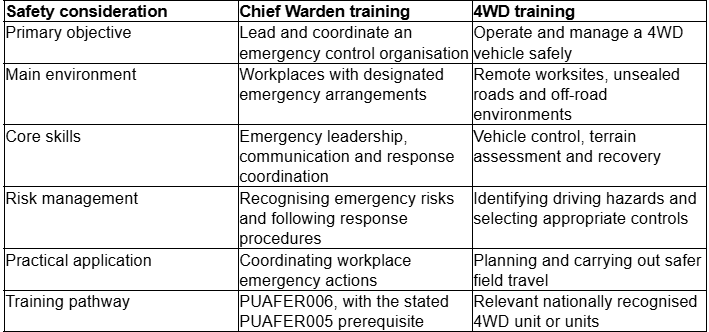
These courses should be selected according to the responsibilities of each worker. A Chief Warden qualification does not provide specialist off-road driving competence, and a 4WD qualification does not prepare a person to lead a workplace emergency control organisation.
Some organisations may need both types of training across different teams or roles.
Building a More Comprehensive Workplace Safety Program
Businesses can improve workforce preparedness by identifying the specific risks their employees face and matching training to their operational responsibilities.
1. Assess Workplace and Travel Risks
Review foreseeable emergencies at work locations, along with risks associated with field travel. Consider building evacuations, access to emergency services, remote communications, terrain and vehicle suitability.
2. Assign Clear Responsibilities
Identify who will lead emergency responses, who will support evacuation activities and which employees are required to operate 4WD vehicles as part of their duties.
3. Select Relevant Training
Ensure designated emergency leaders receive appropriate training and meet prerequisite requirements. Provide 4WD training to workers whose duties require specialist off-road vehicle skills.
4. Establish Practical Procedures
Maintain emergency response plans, evacuation arrangements, vehicle inspection procedures, journey plans and communication protocols appropriate to the work being undertaken.
5. Practise and Review
Use emergency exercises, toolbox talks, pre-start checks and reviews of incidents or near misses to reinforce learning and identify areas for improvement.
6. Keep Training and Procedures Current
Review training needs when job responsibilities change, new hazards are introduced or regulatory and site-specific requirements are updated.
This approach helps organisations treat training as part of a broader safety management system rather than an isolated compliance activity.
Frequently Asked Questions
What does a Chief Warden do in a workplace emergency?
A Chief Warden leads the emergency control organisation in accordance with the workplace emergency plan. Responsibilities may include coordinating wardens, communicating instructions, supporting evacuation arrangements and liaising with emergency services.
What qualification is required for Chief Warden training?
Safety Australia Training lists PUAFER006 – Lead an emergency control organisation for its Chief Warden course, with PUAFER005 – Operate as part of an emergency control organisation as the stated prerequisite.
Who should undertake 4WD training?
4WD training is relevant to workers and other drivers who need to operate four-wheel-drive vehicles on unsealed roads, challenging terrain or in field environments. The appropriate course depends on the vehicle, operating conditions and required competency.
Does 4WD training include vehicle recovery?
The provider offers a unit specifically covering recovery of four-wheel-drive vehicles, FWPCOT3326 – Recover four wheel drive vehicle. The selected course determines which competencies and assessments are included.
Can Chief Warden training replace workplace emergency drills?
No. Training should be supported by workplace emergency plans, appropriate procedures and practical exercises. Drills help organisations assess whether their arrangements work effectively in the actual workplace.
Should employers provide both Chief Warden and 4WD training?
Where relevant, yes. Organisations may need Chief Warden training for designated emergency leaders and 4WD training for employees undertaking field travel. The requirements should be determined by job responsibilities, operational risks and applicable regulations.
Conclusion: Preparing Workers for Emergencies and Challenging Environments
Effective workplace safety depends on preparing people for the risks they may encounter. Chief Warden training develops the knowledge required to lead an emergency control organisation, while 4WD training helps drivers manage the challenges of off-road and field vehicle operation.
For Australian businesses, matching these training options to workforce responsibilities can strengthen emergency preparedness, improve hazard awareness and support safer operations across both fixed workplaces and remote locations.
By combining appropriate training with practical procedures, regular reviews and a strong safety culture, organisations can better prepare their teams to respond to emergencies and manage the demands of their working environments.